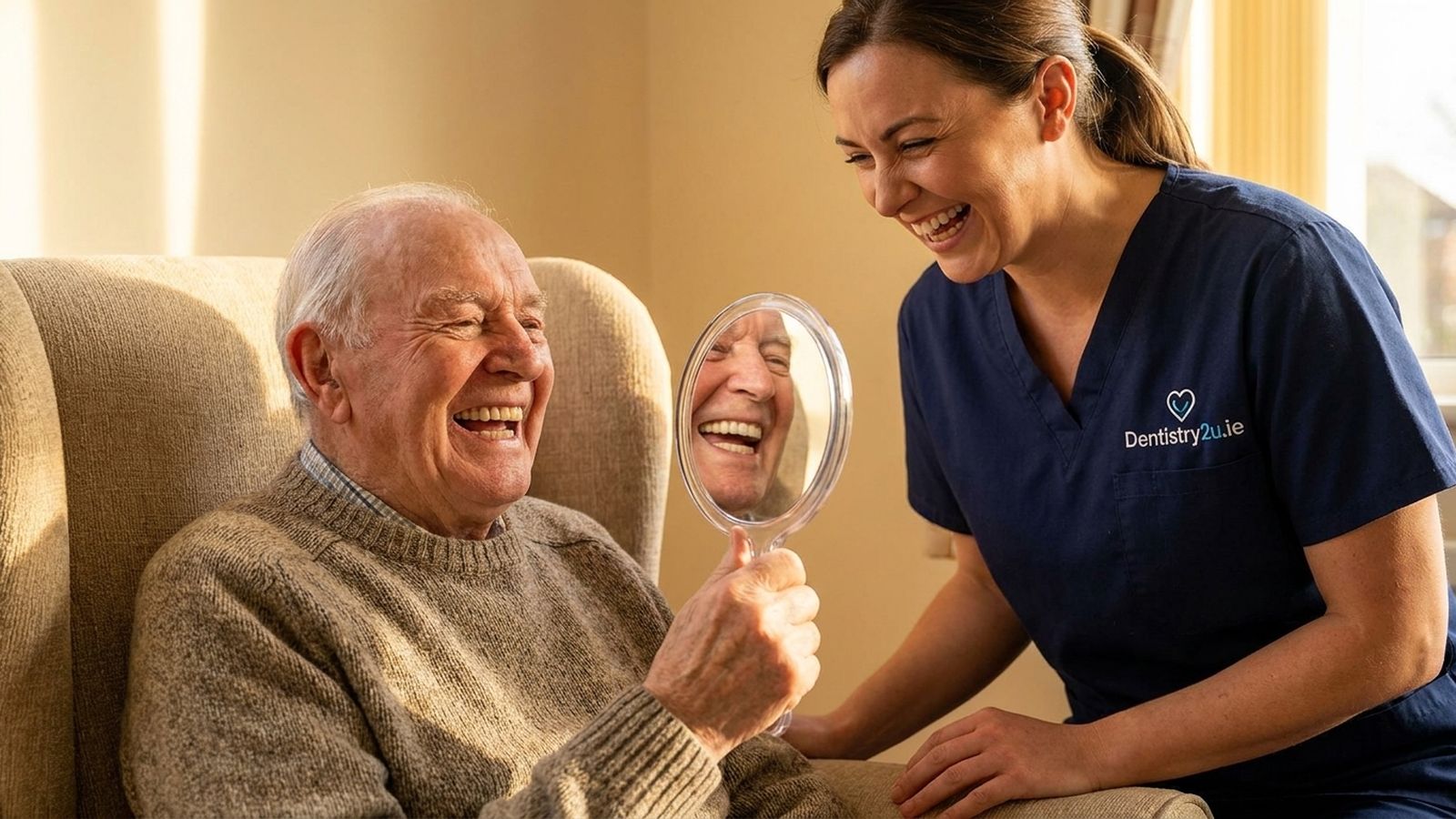
Denture care at home
A loose, cracked or painful denture is the most common reason a family calls us. Most of what it needs can be done in the chair the patient is already sitting in.
A reline is usually done on the day. A new set comes back from our own laboratory in days, not weeks.
Dentures wear, gums change shape, and a set that fitted five years ago can be loose enough to make eating a chore and talking an embarrassment. In a nursing home, a lost or broken denture can quietly turn into weight loss. None of this needs a trip to a clinic.
We reline, repair and adjust dentures at home, and we make new ones — full and partial — using a digital scan instead of a tray of impression material. The laboratory is our own and it is in Ireland, which is why a new set comes back in days.
Who this is for
- Anyone whose denture is loose, rubbing, cracked or lost
- Residents of nursing and residential homes, including people living with dementia
- People who gag on impression trays — the scanner removes the trays altogether
- Families who want a parent's dentures checked at the same visit as an examination
What happens on the visit
Check the mouth first
Before touching the denture we examine the gums and soft tissues underneath it. Sore spots, ulcers and anything that needs attention are found and dealt with, and every visit includes an oral cancer check.
Adjust, reline or repair on the day
Rubbing is eased with a small adjustment. A loose denture is usually relined on the spot with a chairside material. A crack or a lost tooth on the denture is often repaired at the visit; if it needs the laboratory, it goes that day.
Scan for a new set
If a new denture is the right answer, the intraoral scanner takes a digital impression in a few minutes, with nothing in the mouth but the small wand. Shade and shape are chosen with the patient and, where they want it, the family.
Fit and follow-up
The new set is fitted at a second visit, adjusted until it is comfortable, and checked again a couple of weeks later. Denture care advice — cleaning, night-time removal, what to do if it rubs — is left in writing.
Afterwards
A named denture is far less likely to go missing in a care home, so we mark them on request. We ask families and care staff to remove dentures at night, clean them daily, and phone us at the first sign of rubbing rather than waiting for an ulcer.
Cost and cover
Denture treatment is covered for many medical card holders under the DTSS; PRSI does not cover dentures. Where a new set is private, Humm instalments and Credit Union loans are the routes most families use. See what a visit costs and every way it can be paid for.
Questions families ask about this
If your question is not answered here, please give us a call — it is quicker than a form.
Can you really make new dentures without a clinic visit?
Yes. The scan is taken at home, the denture is made in our own Irish laboratory, and it is fitted at home. Some patients need one extra visit for a try-in; we tell you in advance if that is likely.
My father's denture is lost. How quickly can you replace it?
Phone us the day it goes missing. We will scan at the first visit and the laboratory turns a new set around in days. In the meantime we can advise on soft foods so he keeps eating.
Does the Medical Card cover dentures?
For eligible medical card holders, dentures are covered under the Dental Treatment Services Scheme, subject to HSE approval. We check eligibility and apply for approval before the work starts, so there are no surprises.
Will you mark the dentures with a name?
Yes, on request. It is the single most useful thing we do for nursing homes.
Is the denture the problem?
Tell us what it is doing — loose, rubbing, cracked, lost — and where the patient is. We will phone back the same working day.